
During the 2024 General Election, the ANC managed to get 40% of the vote of those who voted. Twenty years earlier, in 2004, the Movement gained effectively 70% of the vote of those who voted.
This massive loss of support occurred during a period of two decades when the ANC had served continuously as our country’s National Governing Party! It communicated the unequivocal message that the majority of our people had lost confidence that our Movement would live up to its historic task of leading the struggle for the total liberation of the people.
In his closing remarks to the ANC Mpumalanga Provincial Conference on the 28th March 2026 President Ramaphosa makes the following observation:
“The fact that the last 15 years economic growth has been quite minimal, in fact has been meagre, leading to the persistence of high unemployment and poverty is something that is of great concern to us. State capture, public and private corruption – illicit financial flows and fiscal challenges, growing inequality have undermined the capacity of the State, its accountability to our citizens, its ability to effectively fight crime and ensure safer communities. And this had manifested itself in declining public trust. People have been losing trust in our ability to address all these challenges.
WE MUST RENEW OURSELVES OR WE PERISH – The ANC must once again make itself attractive to the voters of our country…The ANC must reinvigorate itself, it must strengthen itself and it must ensure that it regains its position as none other than the No 1 political formation that should govern our country.” (my emphasis)
The 15 years that the President is referring to is counted from 2010.
VOTER APATHY – REFLECTS AN EROSION OF TRUST IN THE DEMOCRATIC PROCESS BY THE PEOPLE – DIRECT OPPOSITE OF THE PHILOSOPHY “THE PEOPLE SHALL GOVERN”
From its foundation 114 years ago, our Movement had proudly carried the title – the Parliament of the People! And yet the vote it got during the 2024 General Election means that at best it had come to represent a mere 16,4% of our country’s adult population!
In absolute numbers, 6.5 million people voted for the ANC out of a population of 39.7 million eligible to vote. A massive 83.6% of the adult population did not vote for our Movement.
Add to this the fact that as much as 60% of those eligible to vote did not participate in the 2024 elections. Our 40% of those who voted is 40% of the minority of 40% who voted. This represents the direct opposite of the philosophical outlook fundamental to our strategy, that – The People Shall Govern!
This means that we are confronted by the deeply troubling reality of the threat of the destruction of the ANC and the defeat of the National Democratic Revolution. This is a strategic crisis. It demands that the Movement does what it has still not done – adopt and implement a serious programme to snatch victory from the jaws of defeat!
DEVELOP A TRUTHFUL UNDERSTANDING OF OUR SITUATION
The first thing we must do in this regard is to develop a truthful understanding of our situation, in both its objective and subjective elements. The second is that we must put in place the programme we have mentioned which would restore the ANC to its eminent position of trust in the eyes of the people and put the NDR back on course.
This will demand that we rediscover the courage to speak frankly and honestly to one another as real comrades, determined never to tell lies and to claim easy victories!
In this regard, the comments made by President Ramaphosa serve as an important starting point in that it gives context and an important assessment and evaluation of the political environment.
These comments enable us to drill deeper into the crisis of the ANC and the and the country guided by the operative principles and concepts that he identified in his closing remarks such “15 years of economic growth has been quite minimal – high unemployment and poverty – State capture, public and private corruption, illicit financial flows and fiscal challenges and growing inequality have undermined the capacity of the State, its accountability to our citizens, its ability to effectively fight crime and ensure safer communities. And this had manifested itself in declining public trust. People have been losing trust in our ability to address all these challenges.“
As already pointed out, The 15 years he spoke about is counted from 2010.
Those who constituted the Government during these 15 years cannot absolve themselves from their responsibility for the economic malaise Comrade Ramaphosa laments, with its consequence of persistence of high unemployment and poverty levels.
During the 15-years-long period which Comrade Ramaphosa spoke about, the South African GDP grew every year at about 1%, while it grew on average at 4.5% annually in our peer developing countries. This was because we were not investing in the economy as much as these peer countries were doing.
We were not building new factories, opening new mines, developing the infrastructure, and so on, at the same pace as our peers were doing. Such investment is described as ‘GROSS FIXED CAPITAL FORMATION (GFCF)
This GOSS FIXED CAPITAL FOMATION (GFCF) dropped from 22% of GDP in 2008 to 18.7% in 2018, 15.1% in 2023 and 13.9% in 2025.
And yet the National Development Plan (NDP) has prescribed that this GFCF should reach 30% of GDP by 2030 if our country was to seriously address such problems as unemployment and inequality.
However, the fact is that during the 15-year-period in question GFCF developed in exactly the opposition direction to what the NDP required.
When we look at the quarterly GFCF figures at the end of 2025 for a few countries, we see that South Africa continues to lag significantly below its peers.
LET US LOOK AT SOME EMPIRICAL FACTS
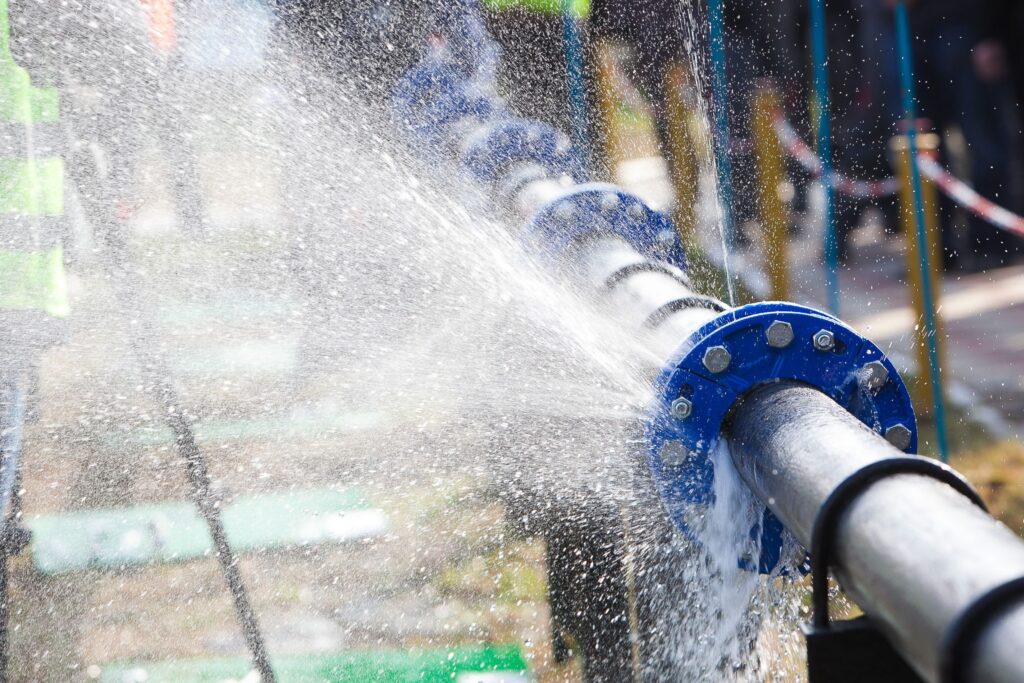
South African municipalities spent a combined total of R2.32 billion on water tanker services, according to the Auditor-General’s water sector audit report. Strikingly, R420 million of that total was flagged as irregular expenditure.
Instead of addressing the root cause by repairing collapsing infrastructure, many cities have normalised tanker reliance. Water tankers has transformed into a highly lucrative recurring municipal expense rather than a temporary emergency measure.
The City of Tshwane spent an astronomical R777 million on water tankers, which was R457 million over budget. Investigations by News24 and political analysts revealed that tanker operations became the largest operational expense in the city’s Water and Sanitation Department, actually surpassing capital investments in pipe replacements.
The city of Johannesburg Water spent R130.5 million on water tankers. While this represents a smaller chunk of the total city budget, researchers noted it constitutes roughly 1.8% of the city’s capital budget—funds that could otherwise be directly used for long-term infrastructure overhauls. Additionally, the city entered into a separate three-year, R263 million water tanker contract, which faced high court challenges regarding its legality.
Gauteng Province Total: Combined municipal records indicate Gauteng municipalities alone spent R2.37 billion on water tankers over a five-year period.
While billions are spent on temporary trucked-in water, the foundational infrastructure continues to decay due to severe underfunding:
The Maintenance Deficit: The Auditor-General noted that municipalities spend an average of only 3% of the value of their property, plant, and equipment on maintenance. This is less than half of the 8% national treasury recommended benchmark.
Financial Losses from Leaks: Due to cracked reservoirs and leaking pipes, water losses cost municipalities R14.89 billion in a single financial year.
In response to allegations of corruption and “water tanker mafias” intentionally undermining infrastructure to secure contracts, the Special Investigating Unit (SIU) has launched probes into municipal tanker contracts.
Furthermore, cities like Tshwane and Johannesburg are attempting to transition away from private outsourcing by buying their own municipal tanker fleets to cut down on middleman costs while trying to raise the massive capital—such as the R29 billion urgently required by Tshwane—needed to permanently fix the underlying pipe systems.
One report states that:
“Water tankers have shifted from being an emergency stopgap to a routine feature of water provision by municipalities. In many communities, especially informal settlements and areas affected by repeated outages, residents now depend on trucks to deliver water for months at a time. This reliance has grown over more than 10 years as ageing pipes, leaking networks, failed pumps, power cuts and poor maintenance have made supply increasingly unreliable.”
In December 2025 the Gauteng High Court declared a Johannesburg Water contract for 70 water tanker worth R 263 million rands invalid because of identified irregularities in the tender process. The heavy reliance on tankers for the supply of water has serious implications for service delivery and the corruption linked to this activity.
A 2023 government report “found that 46% of water supply systems in the country had poor or bad microbiological water quality, compared with only 5% in 2014.”
UNEMPLOYMENT
Since 2010, South Africa’s official national unemployment rate has climbed drastically from 25.2% to 32.7% as of the first quarter of 2026, driven by stagnant economic growth and structural labor market challenges. Data released by Statistics South Africa (Stats SA) confirms that the country’s youth continue to bear the heaviest burden of this crisis, with the narrowest youth cohort facing a staggering 60.9% joblessness rate.
According to the Quarterly Labour Force Survey (QLFS), South Africa’s working-age population stood at 42,2 million individuals aged 15-64 in the first quarter of 2026, up by 121 000 compared to quarter 4 of 2025. This represents the backbone of South Africa’s economy, yet its true potential is concentrated in a notably young demographic.
Of the 42,2 million individuals in the working-age population, 21,0 million (i.e. 49,7%) were aged 15-34 years. Despite their large share of the population, youth labour market outcomes remain unfavourable. In Q1:2026, 5,6 million young people aged 15-34 were employed, while 4,7 million were unemployed and the remaining 10,6 million were outside the labour force.
While the national unemployment rate stood at 32,7% in Q1:2026, the burden was disproportionately carried by the youth, with those aged 15-24 facing the highest unemployment rate at 60,9%, followed by those aged 25-34 at 40,6%.
Young people are not only more likely to be unemployed but are also far less likely to be in employment relative to their share of the working-age population. Their absorption and participation rates continue to be lower than those of adults, while their unemployment rate remains significantly higher, creating a persistent disadvantage for the youth.
The absorption rate, which measures the share of the working-age population that is employed, highlights an unmet need for youth inclusion in the labour market. Among those aged 15-24, the absorption rate was 10,1%, the lowest of any age group in Q1:2026.
While the participation rate for youth aged 25-34 was high at 72,0%, with an absorption rate of 42,8% pointing to a gap of 29,2 percentage points between those actively participating in the labour market and those who were employed.
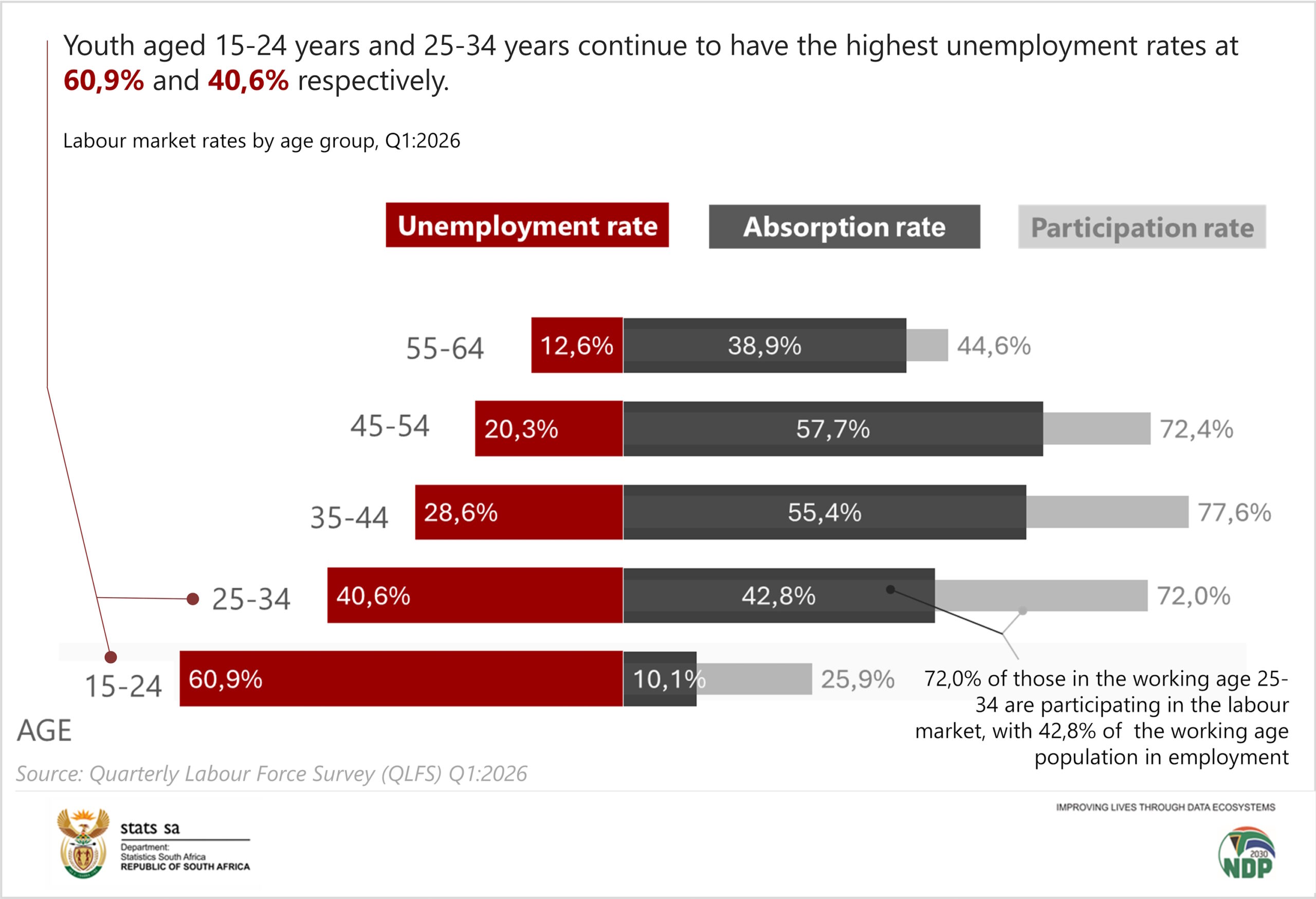
South Africa’s Youth and the Labour Market in Q1 2026 | Statistics South Africa
STATE CAPTURE – PUBLIC AND PRIVATE CORRUPTION
Corruption has become a significant barrier to effective governance and has greatly contributed to the trust deficit. High-profile cases of mismanagement and bribery have not only distracted from essential service delivery but have also fostered a culture of impunity among public officials.
As a result, citizens feel increasingly alienated from the political process, questioning whether their votes truly matter in a system where accountability appears to be an afterthought. This perception of corruption has been particularly detrimental to the youth, who are already grappling with rising unemployment and a lack of economic opportunities.
Service delivery failures further compound the trust deficit, as communities often experience inadequate access to basic needs such as water, education, and healthcare. These failures are not merely logistical; they signify a breakdown in the social contract between the government and its citizens. When people do not see tangible benefits from their taxes and civic engagement, their motivation to participate in democratic processes wanes. The frustration over unmet needs can lead to apathy, particularly among younger voters who feel disconnected from traditional political structures.