
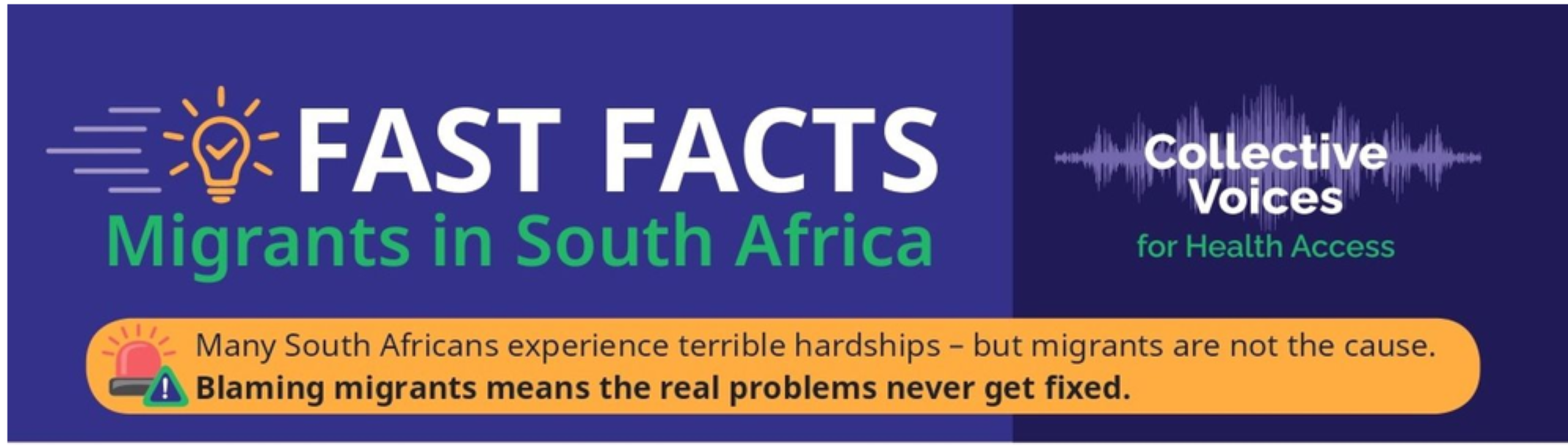

FOR SOME TIME NOW SOUTH AFRICA HAS BEEN SEIZED WITH THE ISSUE OF WHAT HAS COME TO BE KNOWN AS UNDOCUMENTED MIGRANTS. FOR THE GREATER PART THE NARRATIVE HAS BEEN BASED ON SENTIMENTS DEVOID OF FACTUAL EVIDENCE OR IN SOME INSTANCES IGNORANCE AND THE SPREADING OF FALSE INFORMATION. IT CAN BE SAID WITHOUT FEAR OF CONTRADICTION THAT THIS IS THE WORK OF COUNTER REVOLUTION. THE AIMS AND OBJECTIVES OF THIS ACTION IS TO UNDERMINE THE HISTORICAL RELATIONS THAT HAVE BEEN BUILT OVER TIME BETWEEN THE PEOPLE OF SOUTH AFRICA AND THE AFRICAN CONTINENT.
RADIO FREEDOM HAS TAKEN THE OPPORTUNITY TO REPUBLISH SOME FACTS BASED ON RESEARCH AND EMPIRICAL EVIDENCE AROUND THIS MATTER. THIS INFORMATION WAS FIRST PUBLISHED BY DAILY MAVERICK AND WE WOULD LIKE TO EXPRESS OUR GRATITUDE AND ACKNOWLEDGE THE ORIGINAL SOURCE OF OUR INFORMATION.
EIGHT MYTHS AND WHAT THE DATA SHOWS
MYTH 1 – MILLIONS OF ILLEGAL IMMIGRANTS ARE FLOODING THE COUNTRY
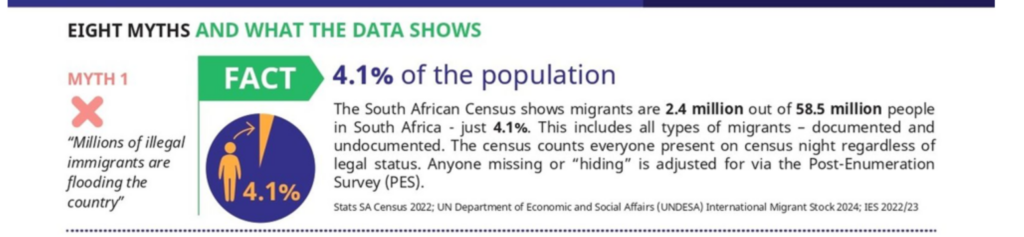
FACT – 4.1% of the population – The South African Census shows migrants are 2.4 million out of 58,5 million people in South Africa – just 4.1%. This includes all types of migrants – documented and undocumented. The census counts everyone present on census night regardless of legal status. Anyone missing or “hiding” is adjusted for via the Post Enumeration Survey (PES)
MYTH 2 – MIGRANTS ARE STEALING OUR JOBS
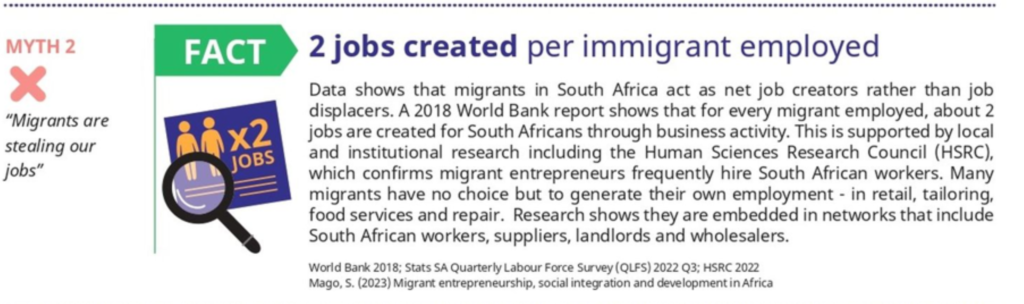
FACT – Data shows that migrants in South Africa act as net job creators rather than job displacers.
A 2028 World Bank report shows that for every migrant employed, about 2 jobs are created for South Africans through business activity. This is supported by local and institutional research including the Human Science Research Council (HSRC) which confirms migrant entrepreneurs frequently hire South African workers. Many migrants have no choice but to generate their own employment – in retail, tailoring, food services and repair. Research shows they are embedded in networks that include South African workers, suppliers, landlords and wholesalers.
MYTH 3 – MANY AVOID PUBLIC SERVICES ENTIRELY
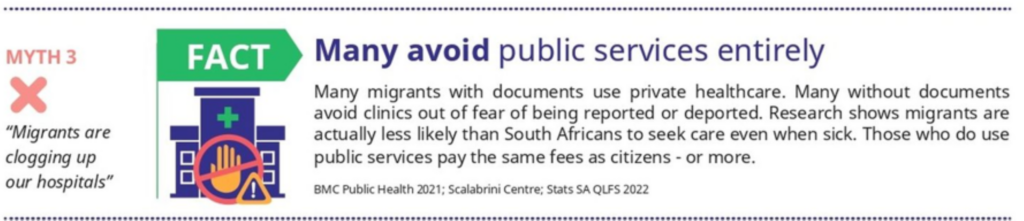
FACT – Many migrants with documents use private healthcare.
Many without documents avoid clinics out of fear of being reported or deported. Research shows migrants are actually less likely than South Africans to seek care even when sick. Those who do use public services pay the same fees as citizens – or more.
MYTH 4 – MIGRANTS ARE COLLAPSING THE HEALTH SYSTEM
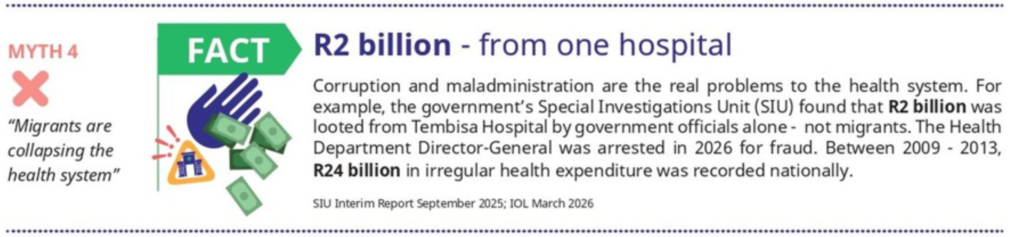
FACT – R2 billion – from one hospital –Corruption and maladministration are the real problems to the health system.
For example, the government’s Special Investigation Unit (SIU) found that R2 billion was looted from Tembisa Hospital by government officials alone – not migrants. The Health Department Director General was arrested in 2026 for fraud. Between 2009 – 2013 R24 billion in irregular health expenditure was recorded nationally.
MYTH 5 – MIGRANTS ARE DRAINING OUR SOCIAL GRANTS
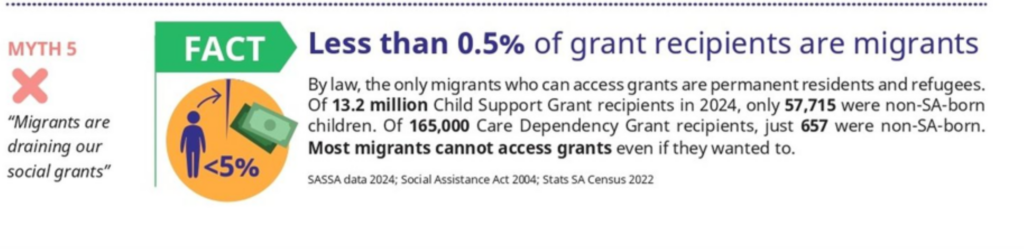
FACT – Less than 0,5% of grant recipients are migrants –
By law the only migrants who can access grants are permanent residents and refugees. Of 13,2 million Child Support Grant recipients in 2024, only 57,715 were non-South African born children. Of 165,000 Care Dependency Grant recipients, jus 657 were non- South African born. Most migrants cannot access grants even if they wanted to.
MYTH 6 – MIGRANTS ARE CAUSING UNEMPLOYMENT
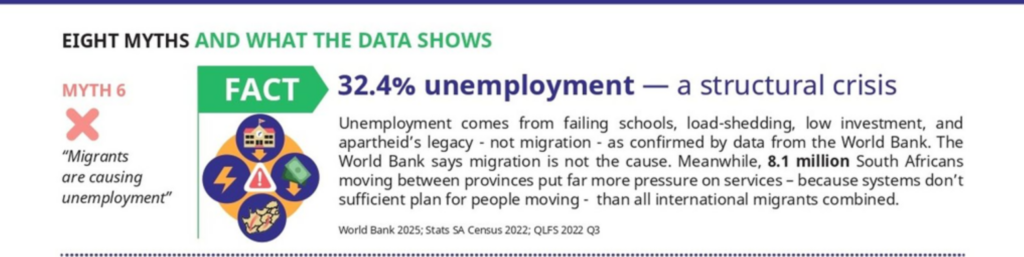
FACT – 32,4% Unemployment – a structural crisis –
Unemployment comes from failing schools, load-shedding, low investment and apartheid’s legacy – not migration – as confirmed by data from World Bank. The World Bank says migration is not the cause. Meanwhile, 8,1 million South Africans moving between provinces put far more pressure on services – because systems don’t have sufficient plans for people moving- than all international migrants combined.
MYTH 7 – UNDOCUMENTED MIGRANTS ARE IN S.A ILLEGALLY BY CHOICE
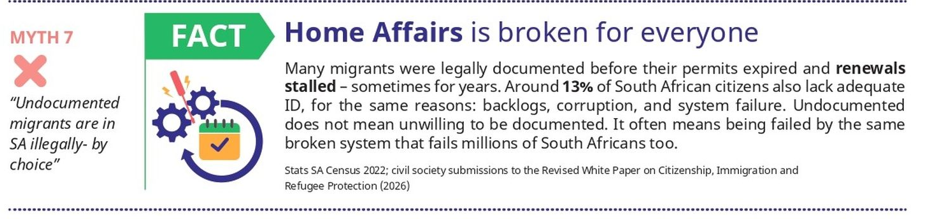
FACT – Home Affairs is broken for everyone –
Many migrants were legally documented before their permits expired and renewals stalled- sometimes for years. Around 13% of South African citizens also lack adequate I.Ds for the same reasons: backlogs, corruption and system failure. Undocumented does not mean unwilling to be documented. It often means being failed by the same broken system that fails millions of South Africans too.
MYTH 8 – MORE DEPORTATIONS WILL FIX THINGS
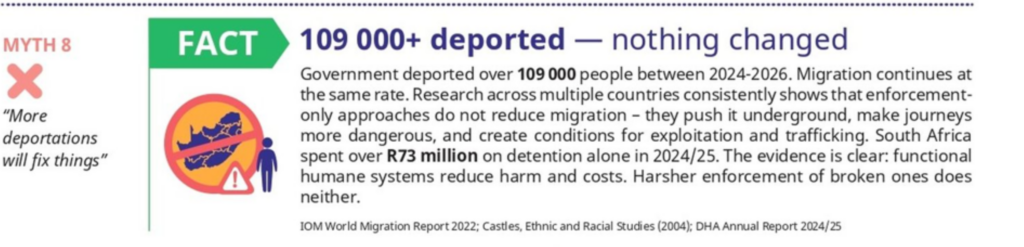
FACT – 109 000+ Deported – nothing changed –
Government deported over 109 000 people between 2024 – 2026. Migration continues at the same rate. Research across multiple countries consistently shows that enforcement only approaches do not reduce migration – they push it underground, make journeys more dangerous, and create conditions for exploitation and trafficking. South Africa spent over R73 million on detention alone in 2024/25. The evidence is clear: functional humane systems reduce harm and costs. Harsher enforcement of broken ones does neither.
NATIONAL CAMPAIGN LAUNCHED TO CONFRONT XENOPHOBIA – DEFEND UNITY AND REDIRECT ANGER AGAINST THE REAL CAUSES OF THE CRISIS
On Tuesday the 9th of June 2026 an online mass meeting was held which was attended by more than 300 people representing a wide range of organisations, social movements, trade unions, community formations, activists and concerned members of the public.
The meeting has initiated a national campaign “to confront the rising tide of xenophobia, Afrophobia, ethnic chauvinism, right-wing reaction and organised hate in South Africa.”
On the 15 June 2026 the group composed of Community organisations, trade unions, civil society formations and concerned members of the public issued a statement to “draw the line against xenophobia, scapegoating and division.”
The statement which has been endorsed by some 134 member organisations says in part:
The meeting was convened in response to escalating threats against migrants and vulnerable communities, including threats of coordinated action leading up to, on and after 30 June by right-wing and xenophobic formations.
Participants expressed deep concern at the growth of organised street intimidation, online hate campaigns, vigilante activity and the increasing normalisation of hateful anti-migrant politics in public discourse.
This campaign, endorsed and supported by over 120 organisations, emerges from the urgent necessity to confront xenophobia, Afrophobia, ethnic chauvinism, reaction and fascist intimidation; to defend working-class unity; and to ensure that the legitimate anger of our communities is directed not against migrants and the poor, but against the political and economic elites responsible for this crisis.
South Africa’s social crisis has reached breaking point.
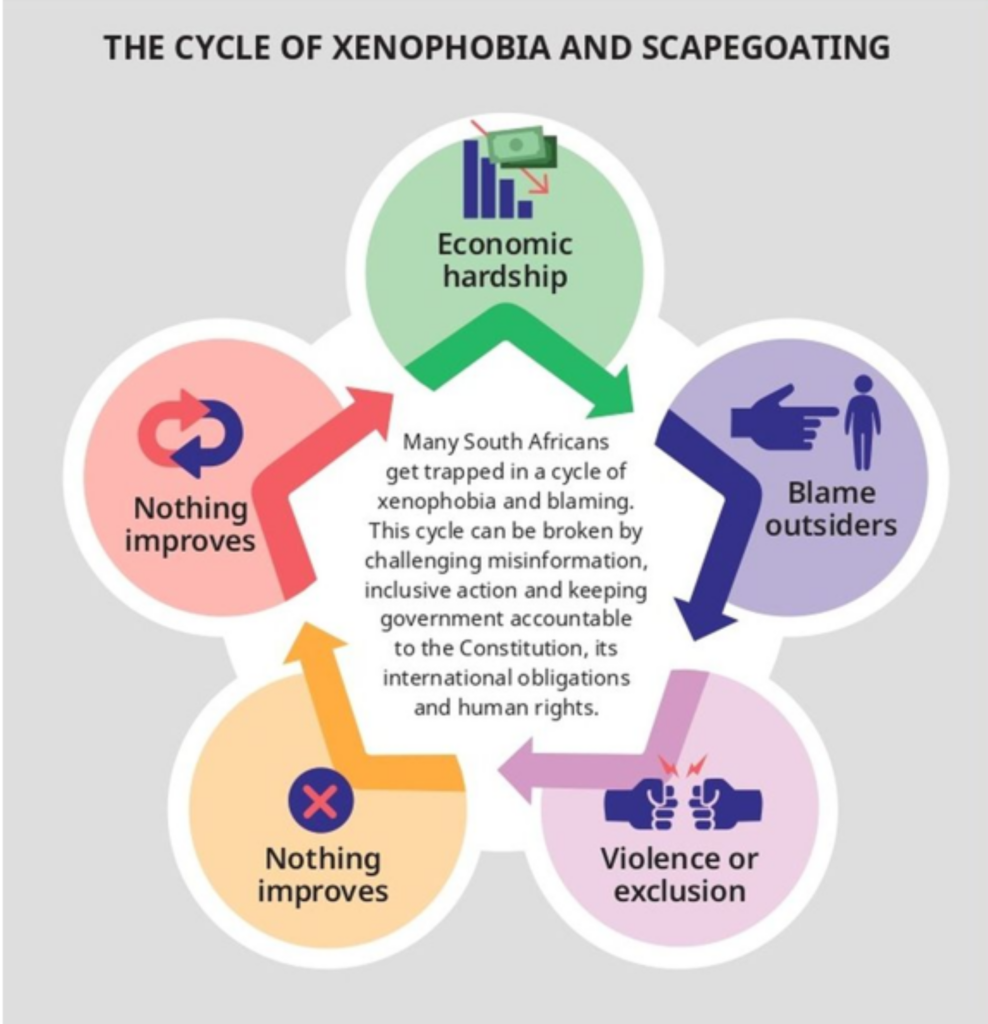
Mass unemployment, collapsing services, corruption, hunger, crime, unaffordable transport and deepening insecurity have produced legitimate anger across working-class and poor communities. But this crisis was not created by migrants, refugees or poor people trying to survive.
It was produced by those with power over society: political elites, big business, corrupt officials, profiteers and an economic system that has abandoned millions to poverty, unemployment and despair.
Xenophobia, Afrophobia, ethnic chauvinism and vigilante politics offer no way out. They will not create jobs, reopen factories, fix municipalities, end austerity or hold the powerful to account.
Once scapegoating is unleashed, it does not stop at the border; it turns neighbour against neighbour, worker against worker, poor against poor. This campaign is therefore rooted in the urgent need to organise the anger of communities away from division and toward the real causes of the crisis.
Supporting and endorsing organisations unite under this campaign on the basis of the following principles:
- We reject xenophobia, Afrophobia, racism, tribalism, ethnic chauvinism and all forms of scapegoating.
- We defend the unity of all who are exploited, impoverished and excluded under the current system.
- We recognise the legitimate anger of working-class and poor communities.
- We oppose vigilante violence, intimidation and fascist methods.
- We fight for jobs, services, dignity and justice for all.
- We build solidarity from below.
Our strength lies in organised communities, workplaces, campuses, faith formations, social movements, trade unions, migrant organisations, youth formations, civics and all democratic forces acting together.


Leave a Reply