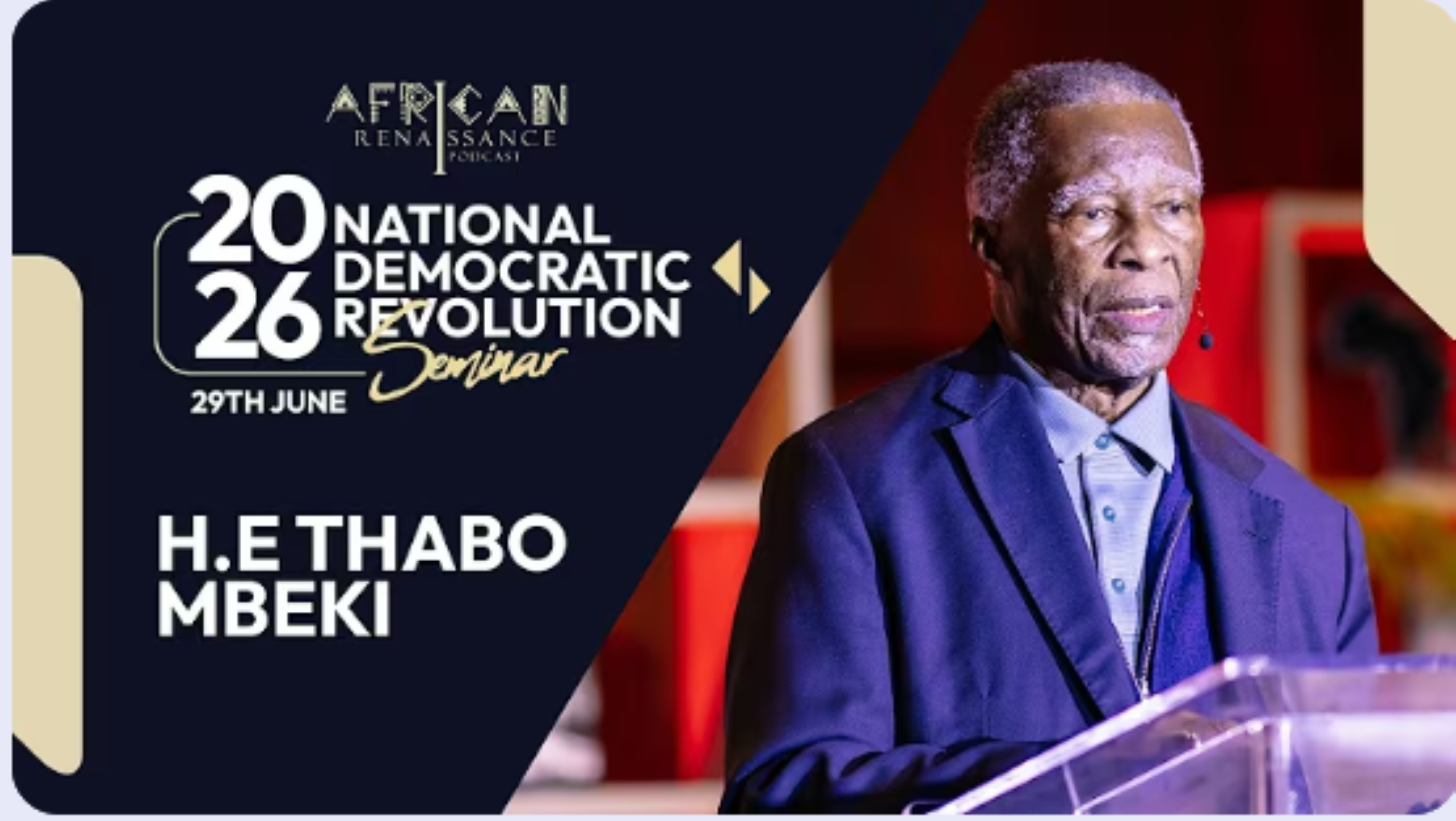
AFRICAN RENAISSANCE PODCAST SEMINAR ON THE NATIONAL DEMOCRATIC REVOLUTION: 29 JUNE 2026
The former president outlines the hidden hand of the Counter Revolution which is dictating the future of South Africa.
OPENING REMARKS
Thanks a lot Mbuyiseni (Ndlozi), I’m glad you’ve given me the opportunity to do what Saki (Macozoma) did – to give myself tasks which are different from the ones you’ve given. No, I won’t depart too far from what you’ve said.
When Mbuyiseni started the meeting, he made a remark which I thought was very important, which unfortunately has not been addressed.
Which was that he knows of at least two books that have been published attacking the NDR. And he had said that he hopes that part of what we will do today is to respond to that attack. He didn’t explain what those books say.
I can guess what they say.
Because the attack of the right wing on the NDR – well, some of the attack – has been that the NDR is a product of Lenin. This is a product of the Communist Party of the Soviet Union. And they accuse us of hiding that fact.
And they say, in terms of what Lenin said, the objective is the achievement of socialism. So that’s – and we can’t avoid that … And this thing which is called NDR is Stage One of the process to get to socialism.
So that’s the big attack. We are in fact, in that context, therefore the argument is that the ANC has been nothing more than a proxy of the Communist Party of the Soviet Union when it existed. And in fact, one of the people who are critics of the ANC, NDR and all that, says that the ANC actually went brain dead when the Soviet Union ceased to exist.
It went brain dead because it was the Soviet Union which was thinking for the ANC. So I’m saying that the argument in these books is that the NDR, in fact, is Stage One of a process leading to socialism. I’ll come back to the question of why the right wing is putting the matter in this way.
THE NATIONAL DEMOCRATIC REVOLUTION
National democratic revolution is about two things. It’s about national liberation: that’s the National. And it’s about democratic change, democratic rule: that’s the Democratic.
So when we talk about national democratic revolution, we are talking about national liberation, the liberation of the oppressed. That was part of our own struggle. National liberation, the liberation of the oppressed.
The second part was that that liberated South Africa must have a democratic system of governance. To understand that when we say national democratic revolution, that’s all we’re talking about. These two elements.
So there is no final definition beyond that of NDR. Because we must then say national liberation must be achieved – the task of the NDR. But exactly what does that mean? What does it amount to?
All right, it must mean, one of the things is that this formerly oppressed people must also have a right to vote and to be voted into power. Let’s end white minority domination. We end white minority domination.
But is that the end of the liberation we are looking for? No, it cannot be the end.
That’s a political decision.
We’ve got to say it can’t end just with the vote. It must have economic consequences, this consequence, that consequence, that consequence. So when we talk about our national democratic revolution, this National part, which is national liberation, what are these elements?
So that we would say in terms of our national democratic revolution, these are the things that need to be achieved in terms of the national liberation. I don’t know if there’s anybody here who can tell me what they are.
National liberation, when I say political liberation is not sufficient, it has also to be economic liberation. So what does that mean? Some of these questions that were raised by Saki (Macozoma) need to be answered.
The democratic part, I’m sure colleagues you understand the importance of it.
If you look, for instance, at what the MK Party are saying: one of their principal demands is that, sure, it’s very good that we’ve got this society that we have liberated from apartheid.
But power must be given to the traditional leaders. So in their concept, this Democracy has disappeared.
So they’re not talking NDR, they’re talking NR. The Democracy is gone. It must go to the traditional leaders. These are the people…So that is why it’s an important thing, this thing, Democracy.
You can’t just say national liberation. The question of how does a liberated country become governed is important. I’m mentioning this thing comrades, just to say, in our response to the challenge that Mbuyiseni (Ndlozi) put, at least two books have been published.
They are challenging the NDR. I’m saying that challenge basically is a complete distortion of what the NDR is. And they say it’s a product of a theory by Lenin, and in reality, is Stage One in a process leading to socialism. I’m saying I will come back to that matter as to why they make this claim.
We’ll have to find time, I don’t know when, Mbuyiseni, to look at that. When we say national liberation, exactly what are the things that we want to achieve?
I think I heard somebody there saying that the State must own the economy – that that would be part of our definition of the achievements of national liberation.
On the democratic side, you get questions that we need to answer. For instance, this debate about the role of parliament.
I keep saying to people, people forget that the ANC was very central to the drawing up of this South African Constitution. If the ANC had not said yes, there would be no such Constitution. So the things that are in that Constitution, this 1996 Constitution, are very much ANC policy.
And one of the things that is in that Constitution is this issue of the oversight of the executive by the legislature.
That’s an ANC position. The issue about a constitutional democracy as opposed to a parliamentary democracy, that’s an ANC position.
So that’s why I find it puzzling that comrades who sit in parliament, who are ANC, find it difficult when you’ve got this responsibility to exercise oversight over the executive as prescribed by the Constitution. You say, no, no, we can’t do it if the president is our member. That’s in violation of ANC policy.
You should say as an ANC member of parliament, this oversight thing over the executive is in ANC policy. It doesn’t matter that the president is an ANC member. We must exercise this oversight.
I’m talking about this in the context of democracy.
National liberation. What are these things that need to be done in that context such that we say it is sufficient?
In terms of democracy, what are these things that need to be done such that we say the national democratic revolution has succeeded? There’s no such definition, because these two struggles will vary from time to time.
The rest of the Continent, coming out of the colonial period, is also faced with challenges of national democracy. In Ghana or Nigeria or wherever, it’s also the national democratic revolution. This rebellion in North Africa called the Arab Spring, it was about the same issue – an incomplete national democratic revolution in North Africa.
So I’m saying, colleagues, in terms of answering this challenge which Mbuyiseni posed, we must fight against this misrepresentation of the NDR by the right wing.
We ourselves must understand what we mean by NDR and do then this fighting.
I’ll come back to that.
UNDERSTAND OBJECTIVE REALITY IN DETAIL
Trevor (Manuel) raised an important matter – other people also – about the need for us really to be as precise as possible, to understand what are these things we are talking about.
Saki, like Trevor, was saying we mut be afraid of slogans.
UNDERSTANDING THE NATIONAL DEBT
Trevor mentioned a section in Volume I of Das Kapital on the matter of the public debt. I was very glad he quoted that.
When Marx discusses the public debt, Marxists would say, he presented a scientific approach to this issue, not slogans. And one of the things that Marx says in that discussion, is that in a capitalist society the only thing owned by the working class is the public debt. So, you can increase the public debt. In the end, it’s the working class that will pay.
That’s the point he (Trevor) was making. That’s why he (Marx) refers to it as an inherent part of the primitive accumulation that Trevor was talking about. Certainly, for those of us in our country who think of themselves as Marxist Leninists, they need to take that on board.
When we deal with the challenge of the national debt here, I’m saying for those people who are Marxists and Leninists, they should say, this scientific approach to the issue of the public debt by Marx, how does it apply in our case?
CHINA AND THE NATIONAL DEBT
It relates, for instance, in a more practical way, to what has happened in China, where the Chinese spoke about opening up, open door policy, under Deng Xiaoping. An important part of that opening up process was that, to build socialism in China, you need capital.
The money that you need to build a factory, to build the railway line, to build whatever, you need capital. And the Communist Party of China took a decision that it was not possible for China to generate the volumes of capital it needs in order to build socialism.
The open-door policy, had this very important element, that we must access the volumes of capital that are available in the rest of the world, including from the Chinese Diaspora, some of whom had become big businesspeople, more billionaire than Saki is.
I’m saying an important part of the open-door policy was to attract this capital.
It was not to run budget deficits in order to generate the capital.
They took a decision, which I think was a very correct decision.
We need these volumes of capital in order to build socialism. Let’s go for this capital where it is. We’ll open doors, let it come.
Even today, we see today, I read an article not long ago, that if you look at the working class in China that is in manufacturing, the bulk of the factories (in the manufacturing sector) there are privately owned. When the Chinese talk about socialism with Chinese characteristics, it’s part of what they are talking about, access to capital.
The matter is very, very relevant to us here when we talk about the National Democratic Revolution.
Saki raised this question and correctly said, among other things, let’s look at the savings in the country in terms of the capital we need.
You hear some of this debate against austerity, and I listen. What I don’t understand about some notion, I don’t know where it comes from, that unlike what the Chinese said, we believe the State, even if before the GNU, that the State would be able to generate these volumes of capital we need in order to achieve the development that we need, and it can’t.
There are huge volumes of capital which are in private hands here and the rest of the world. Capital in the rest of the world, globally, is in private hands, and I’m saying the Chinese Communist Party, Communist Party of China, understood this and said we need that capital.
THE EUROPEAN UNION AND CAPITAL TRANSFERS
You know the European Union, they have a, I think it’s called, or it was called, maybe still called the geographic something, geographic policy, something like that.
[It was, in fact, called the Regional Policy.]
When they took a decision that they must become an economic community, and therefore you must reduce, remove all these tariffs so that they can work together, that you need to create a level playing field, so that all of the members of the EU are able to compete in this open economy among themselves, (in the) free trade area.
And in order to do that, they said we’ve got, we have no choice as the European Union, but to transfer capital from the richer countries to the poorer ones. (This meant) a systematic process of the transfer of capital from the richer EU countries to the poorer ones, like Ireland, like Portugal, like Spain, so that to develop them so that they can compete on an equal basis.
SOUTH AFRICA AND THE NEED FOR CAPITAL
I’m saying the role of capital, where does it go? We need it here. We need huge volumes of capital in order to achieve these objectives that you would put in terms of national liberation.
In terms of national liberation, its accomplishments must be the following. Some of them will be about the economy, and I’m saying we’re not going to get the sort of growth rates that we need, and therefore the investment levels we need, if you say we’re going to depend on a government which must eliminate austerity. I’m not saying the government must follow austerity policy, but I’m saying that this government has no possibility to generate the resources, the volumes of capital that we need.
And therefore, when we talk about the NDR, the question arises, what’s the relationship between the democratic state and capital? The issue that was raised by Comrade Silumko Nondwangu is a very legitimate question.
When we were discussing at some point with some of the Ministers in Government about the Social Compact, (one) Minister we met with Comrade Max, said to us that he has found a problem.
They took some decisions in (his) Department about what needed to be done about whatever, and that needed cooperation with the private sector. And he says we took a decision that this must be done in terms of the developmental state and all that.
He discovered after a year that nothing had moved.
When he went into this, he found that there was an ideological fixation, and they (the civil servants) were claiming that it comes from Luthuli House, that the enemy of the NDR is private capital.
And (yet), the Minister said to us, in order to achieve their objectives, they must cooperate with these people, private capital, (who were described as) the enemy of the NDR. And the Departmental staff were claiming that this thing comes from Luthuli House.
So I’m saying that it’s a very relevant question. This matter that Trevor has been raising, insisting upon, therefore we look at these things that we are talking about in the detail. And Saki says, let’s run away from slogans.
SO CALLED XENOPHOBIA – FROM 2008 ONWARDS
We made a mistake in 2008 in government. I’ll explain just now what the mistake was. In 2008, the story goes like this, that in 2008 there was a very bad outbreak of xenophobia in the country, as a result of which at least 62 people were killed, and so on.
It’s true, there was that, something happened, and so many people were killed.
I’m saying the mistake we made is this. The intelligence service at the time, which was in better shape than it is today, actually looked at that matter in Alexandra Township, that’s where it started. That thing was not xenophobia from the ordinary people of Alexandra saying we hate these Africans, it didn’t come from that.
It was a deliberate decision to drive as many Zimbabweans as possible to go and vote in Zimbabwe, in that 2008 election in Zimbabwe. And intelligence, our intelligence did all the details.
Who started it, what meetings took place at Madala Hostel, who was at it, all of that.
It was a very deliberate conscious attempt. You would remember, even those who weren’t around, that the MDC in Zimbabwe even said, we’re going to send buses to come and fetch those people.
Intelligence did a very detailed report about what that thing was.
It wasn’t xenophobia. It was not xenophobia in the sense of – we hate these Africans.
It was somebody who said, even more or less by definition, the Zimbabweans who’ve run away (and are) now in South Africa, almost by definition will be against ZANU-PF.
We need them in Zimbabwe to go and vote against ZANU-PF.
In that group, which was responsible, they tried to do that, mobilise in Khutsong on the West Rand. There’s a long report, you’ll find it on the internet, on Khutsong.
The local leadership in Khutsong of the ANC, the Communist Party, the trade unions, they said, no, we’re not going to join that. There was no sign of any kind of any xenophobia in Khutsong. It was a political decision of the leadership, because the masses of the people in Khutsong or Alexandra, people in Alexandra ordinarily, they didn’t say – we want to chase away the Zimbabweans.
It was a political decision.
I’m saying the mistake we made, comrades, was that we should actually have declassified that Report from intelligence. I’ve said this publicly, that I hope the government now can declassify that Report so that people can understand – the kind of detailed clarity that Trevor is asking for.
Practically, what is happening in our country? All instances of so-called xenophobia, all of them, except in this current one, whether you’re talking about Cape Town or Durban, all the instances that we’ve had of these things, there are organisers. There are reasons for it.
In the Cape Town townships, it was a fight among traders, so that in the end, they sat together, all the traders, like Khayelitsha, and said, let’s have an agreement among ourselves, the traders. These parts of Khayelitsha, it’s us, the domestic ones, we’ll have our shops. You, Somalis, or whatever, that section.
And price, bread, this and that, let’s not compete on price. They had a very detailed trading agreement, and that was the end of the violence. It’s because you don’t have an instinct in favour of xenophobia among the ordinary masses of the people.
The people that Comrade Vavi represents, his workers, they don’t instinctively say, we hate foreigners. Somebody else goes and organises them, like now, what is happening today. It’s not because the masses of ordinary people woke up and said, we don’t want undocumented people.
It’s organised.
But I’m just citing these instances, colleagues, to say, we need to listen to this appeal. In order to discharge this function of ours of leading, we’ve got to empower ourselves with the truth, not slogans.
ESKOM AND LOAD SHEDDING
One of our colleagues, Portia Derby, talked about Eskom. In November, December 2007, there were instances of load shedding by Eskom, but they were regional. Those of us who are old enough will remember that.
I was already President of the Republic at the time, and I apologised for that, because the accusation was that it was because of failure of government to do whatever. But they were regional instances of load-shedding.
The first national load shedding was in January 2008.
Again, you remember that. The mines, for instance, closed for a whole week, in January 2008. I had to deliver the State of the Nation Address in February 2008.
You find it on the internet. I apologised again on behalf of the government.
Many, many years later, I read in one of the newspapers, I’m not supposed to advertise, so I won’t mention the title of the newspaper.
And the newspaper says, one of these Special Investigation Units was commissioned to look at some problems at Eskom. In 2014, the Unit was set up, and it looked at whatever the problems were, and reported to the President in 2017. That Report, says the newspaper, has never been released.
But fortunately, we have managed to, somebody leaked it to us, the Report. And they say, the SIU said that Eskom had an internal monitoring system, because there was a regulation that each one of the power stations, coal-fired, had to make sure that it has got at least 22 days’ supply of coal at each station, at all times. So, there was an internal monitoring system, which watched all of these coal stocks.
And from November 2007, this monitoring system started alerting the individual station managers.
You are running out of coal – replenish!
November, December, I’m saying you’re beginning to have this load shedding, the power cuts.
I apologised for this state, until we had this national shut down in January 2008. I apologised again.
So, this newspaper says that what this report of the SIU says about that is that what happened was, the managers of the power stations, they ignored these alerts from the warning system.
When it said – replenish!. replenish!, – they did not replenish. That is why we had a complete power cut in January 2008.
The station managers just didn’t replenish. So, they ran out of coal, deliberately.
And in terms of the rules and regulations of ESKOM, once a thing like that happens, you declare an emergency.
And one consequence of the emergency is that you don’t need to tender. You just go and buy the coal from whoever has got coal. And that immediately doubled the price of coal to ESKOM.
It was deliberate, conscious. I apologised. So, when I read this thing in the newspaper, I said, how foolish was I?
But I didn’t know. As far as I know, that Report has still not been released. I’m mentioning it to say, that should have alerted us to something.
If we had known, that Report would have alerted us to something that there are some bad elements in that ESKOM who do a thing like that. We didn’t know. That’s why we had to apologise.
I said, wrong decision. It was the right way to respond, given the information we had. But in the substance, given the actuality of what happened, the problem needed a much better response than an apology.
But we didn’t know. We didn’t know the truth.
NUGENT COMMISSION ON SARS
Not long ago, I was asking, there was some meeting, and I was asking a group of Professors there about some questions.
I said, can you please answer these questions?
In 2018, President Ramaphosa appoints the Judge Nugent Commission on SARS. Why was that commission, judicial commission appointed?
What did it decide? What are the implications of what it decided to South Africa today?
And literally, the Professors didn’t know.
So I said to them, the Nugent Commission was appointed because for many years, when Trevor was Minister of Finance, SARS was outperforming itself in terms of collections. And sometimes during then, they would say, we’re going to collect a billion rand. When it comes to the end of the financial year, they’ve collected a billion and a quarter.
It went on like this, always outperforming. Until around 2014, when it went in the opposite direction. SARS started underperforming.
That’s why the Commission of Enquiry was appointed by President Ramaphosa.
To say there’s something wrong means there’s something that’s gone wrong. Why is SARS suddenly behaving in the opposite direction to what it normally does?
The conclusion of that Nugent Report, not using the words I’m going to use, but the conclusion is – there were people, some of them in government, most of them in government, who took a deliberate decision to destroy SARS. And bear in mind, SARS is responsible for 95 and whatever percentage of state revenues.
There are people who took a decision to destroy SARS.
And to destroy SARS means to destroy the democratic revolution.
And then they spell it out. The practical steps that were taken in order to achieve that destruction of SARS.
And that is why, it was because the process of destroying the institution was working, that it began to show this thing of SARS underperforming. Fortunately, that is what sounded around the alert bells.
The Zondo Commission follows that up, also looks at SARS, agrees with what Nugent said, and goes further.
The Zondo Commission says, one of the things that they found is that the then President of South Africa was directly involved in the process to destroy SARS. What I’m saying, colleagues, is in black and white. The Reports are on the internet, you can fish them out. What does that mean?
As I say that when I posed this question to the Professors, they hadn’t read the Nugent Report. I don’t know how many of us here have read it. It’s been on the internet since 2018.
But it contains this very, very important issue, in a sense similar to what happened with regard to ESKOM and the power failure in January 2008.
We’ve got people among us who are up to something that’s wrong. So, I can cite other instances.
I am trying to emphasise the point that Trevor was making, that Saki was making, as Nkosazana Dlamini-Zuma was asking for, as Zwelinzima Vavi was asking for, to exercise this, to carry out this task of leadership, you need to empower yourself with the truth, with the knowledge of this actuality that I have been dealing with.
This person who sits next to me, whom I call comrade, is he a comrade? Or is he Mr. and Mrs.? It’s important to understand that, and the point about a proper grasp of objective reality I think was very well made. I’m just illustrating some of that.
THE OSSEWA BRANDWAG, ANTI – COMMUNISM AND SUPPRESSION
The ANC gets established in 1912, the Communist Party in 1921, all sorts of things happen afterwards.
During this period from the founding of the ANC until maybe the beginning of the 1940s, there’s no political institution in the country which has got as part of its programme a decision that the Communist Party and its friends must be defeated and destroyed. It doesn’t exist. I’m saying during this period.
The matter of the defeat and destruction of the Communist Party and its friends comes up in the 1940s. It arises in the Ossewa Brandwag formed in 1939 as a so-called Afrikaner nationalist group.
This matter comes up in the Ossewa Brandwag, and you’d remember that the Ossewa Brandwag saw itself as the representative in South Africa of the Nazi Party in Germany.
So that you find that the slogans, even these symbols and so on, they’re directly taken from the Nazi symbols. It was sympathetic to the Nazis and even went on a sabotage campaign here in support of the Nazis, etc.
The Ossewa Brandwag, that’s the first time you get a political formation in this country which says not only must the Communist Party be defeated, it must also be destroyed, including everybody who’s associated with that Communist Party. Same thing.
That’s the Ossawa Brandwag, many of whose members end up in the National Party. That’s why you find J.B. Vorster, P.W. Botha, C.R. Swart, all of these people in the National Party.
They come from the Ossewa Brandwag and they come into the National Party and part of its programme becomes this one – the defeat and the destruction of the Communist Party and their allies. Which is why in 1950 the National Party, National Party government adopts the Suppression of Communism Act.
It was an expression of this decision – I’m saying not only to defeat, but also to destroy. To make sure that thing ceases to exist. The first time it finds a political home, that kind of sentiment is in the Ossewa Brandwag during the 1940s.
It’s carried into the National Party.
To cut a long story short, one consequence of that is that when 1994 comes and we’re celebrating – Free at last! Free at last! – this group, a group within the National Party is saying, these ANC people are celebrating a victory in a battle, which we couldn’t stop, but we will win the war. Because the fact that the ANC is now a governing party has not changed the fact that it’s our enemy, which must be defeated and destroyed.
THE ORGANISED COUNTER REVOLUTION IN ACTION
So, there’s a formal Counter-Revolutionary group that has formed, whose task is the defeat and destruction of the Communist Party and whoever is associated with it.
A major player is the Defence Intelligence of the SADF, which was very central in terms of the formation of that Counter-Revolutionary group.
One of the decisions that group took was, we’ve got to change the leadership of the ANC, because if we don’t change that leadership, the Counter-Revolutionary project will fail.
They first took a decision to intervene in the ANC at the 2002 Conference in Stellenbosch, where they were going to intervene to produce a change in the leadership of the ANC.
Then decided at last minute, no, they were not quite prepared, let’s postpone. They postponed to 2007.
ACCELERATED AND SHARED GROWTH INITIATIVE (ASGISA) SHREDDED
Trevor was saying, for instance, part of the evolution of ANC economic policy was ASGISA. Part of what ASGISA said, the reason for that ASGISA, was that we looked at what we had been doing since 1994, RDP, GEAR and all that.
And we said the impact on the reduction of the levels of poverty is not good enough. We need to make other interventions to impact on this issue of poverty. That’s one of the elements in ASGISA.
We even set up what was called a War Room, which was led by Deputy President Phumzile Mlambo-Ngcuka, to focus on these elements of ASGISA, which must achieve these objectives in the RDP. The RDP was never abandoned. And the things that we’ve been doing are not sufficient, we said.
And Comrade Trevor said correctly, then came the change in Polokwane. And he used the word shredded.
ASGISA was shredded. There are other things that were shredded.
There is Airbus, the European company.
A400 PRODUCTION SHREDDED
They were working on a military transport plane, A400 or something. And they formed a consortium of a number of European countries and others to co-produce this plane.
And fortunately, one of the countries there said, but South Africa is carrying out a lot of peace work on the Continent and therefore needs this big transport plane to move soldiers and equipment and all that. Why don’t we invite them to join this consortium?
So they approached us, we agreed. We joined the consortium.
That integrated the aircraft manufacturing companies here at home in the global aircraft manufacturing system. So, we became part of one of the sunrise industries that Saki is talking about, with modern technology and all that.
Came Polokwane, they shredded it.
ESKOM was working on a pebble bed, what was called a pebble bed nuclear generation station, a modular reactor, pebble bed, using pebbles and all that – very advanced, very.
PEBBLE – BED NUCLEAR REACTOR SHREDDED
I visited China during that period. And one of the places we visited was Tsinghua University. Tsinghua in Beijing is one of the leading universities in China.
And they gave me one of those pebbles. They said they are working with ESKOM to develop the balls that would be used in the pebble bed station. It’s really very advanced nuclear technology.
Came Polokwane, they shredded it.
And the scientists and engineers, we lost because of that shredding, emigrated to the United States. None of those shreddings was accidental.
I’m saying that the Counter-Revolution takes a decision. The ANC must not only be defeated. It must also be destroyed. The reason they are able to intervene at an ANC National Conference, they are counting on their agents in our ranks.
AGENTS OF APARTHEID
Because there was a very serious level of infiltration of the liberation movement by enemy agents. Certainly, I know from the ANC side, that we did everything to make sure, to try very much to weed out this sort of people. We didn’t succeed entirely.
I don’t know the percentage of success either. But I know for a fact that many of those agents remained in the Movement.
When the Counter Revolution takes a decision, we are going to intervene at an ANC National Conference in order to produce an outcome that’s in our favour, it’s because it knows it’s going to count on the people it had placed inside our Movement.
And part of the challenge about that is that what the regime did was not only to infiltrate the ANC and COSATU and the Communist Party and then the mass democratic movement and all that, but society itself, academia, business, media, society generally, to empower itself to be able to defend apartheid.
THE NATIONAL SECURITY MANAGEMENT SYSTEM (NSMS)
And I’ve been saying, comrades, that one of the important structures of the apartheid system for the purpose of its own defence was this thing, National Security Management System. The National Security Management System put in place by the regime was prepared perfectly for the defence of the apartheid system.
And one of the things it did was to make sure that it got as many agents as possible in the African townships, who are the people who will alert it if there’s security challenges.
NSMS AND KZN
And I’m saying to comrades that to understand the success of the MK Party in 2024, you must understand the uses of the National Security Management System in the case of KZN, because it was never dismantled.
During the July 2021 mayhem, and you hear people saying, the accusation is that this arose because of divisions in the ANC. Allegedly, there were some people that were against JZ and people in favour of JZ. And when he got locked up, the JZ people got angry and la, la, la, la. It’s not true.
That thing in July 2021, was because Counter-Revolution took a decision – this one that says the ANC must be defeated and destroyed – it took a decision to test, test itself.
Have we got the strength and possibility to destabilise this country?
And they did.
That’s what that whole thing was about – nothing to do with Zuma.
There’s a former general of the SADF, General Roland de Vries. General Roland de Vries was a deputy commander of the South African army of the SADF at the time of change, ‘94.
And Roland de Vries says in an interview, it’s again, it’s on the internet – he says that test in July 2021 showed that the State in general, including the police, had no possibility or strength to protect this democracy.
The Counter-Revolution proved this point, that if it wanted to overthrow this democracy, it could. It used this thing about the arrest of Jacob Zuma as just a cover, it’s a legend. So, all of us must look in that direction instead of looking at the real cause of the problem. That’s what was July 2021.
Comrades from Durban will tell you that for those comrades who had moved into the historically white suburbs, during that period, they could not enter the suburbs to go to their own homes. Because there were roadblocks on all roads entering the suburbs.
And the roadblocks were staffed by white men carrying military rifles. Not police, but white men in their private clothes, carrying military rifles. And you had to show them your identity documents and convince them that you live there.
And the reason they had those units just now in July 2021 is because the commando system, the citizen force of the SADF, was never dismantled. The National Security Management System is in place.
THE TRC AND THE NSMS
We raised this thing with the TRC, the ANC did.
We said, can you please help us in your work? Do as much work as you can to expose this National Security Management System, because if it’s left intact, it’s going to cause problems tomorrow.
They tried, the TRC tried. You’d find in their records some hearings on the National Security Management System. But this didn’t go very far.
I’m trying to cite comrades what has been happening. And the task that it set itself, that Counter Revolution, I’m saying, was the ANC must be defeated and destroyed. And some of what must happen, it must fail to govern.
THE COUNTER REVOLUTION AND THE DEMOCRATIC STATE
I think it was Trevor or Nkosazana and I can’t remember, who said look at the collapse of the State Corporations. Trevor was correct saying, here was ESKOM, a superstar among the utilities globally.
It started going down. Transnet, Denel, SAA, the whole bundle of state corporations from 2009 onwards.
The thing that Portia was raising is correct.
A radical reduction in the role of the state in the context of the mixed economy she was talking about. A radical reduction of the capacity of the state to play a role in terms of leading that economy. A systematic destruction of the State Corporations.
This didn’t happen on its own. Some people say it was because of cadre deployment. It’s not. It wasn’t cadres. It was not wrong cadre deployment.
THE ESKOM MEDUPI AND KUSILE POWER STATIONS
Kusile and Medupi, power stations, were supposed to, in terms of the planning, should have been completed by 2014, 2015.
Kusile, they started constructing Kusile in 2008 and should have completed in seven, eight years. Each of these, both of these power stations, each have got six operating units.
Ten years after the start of the construction of Kusile, not one of these units was operating. Not one.
What happened was that management of ESKOM put out a tender for somebody else to come and help them to solve this problem. They had failed to build just one of the six units.
That tender was won by an Indian company which belonged to the, you know, the Tata Brothers. Tata is one of the big conglomerates in India. They had a company which dealt with building power stations.
And they won that tender. And part of the reason they won it was because they had a very similar power station that they’d built in India. So, they won the tender anyway.
So, they came to build this one unit at the power station, with time frames and all of that. They completed the power unit within the time given, within the costs given. Everything was fine.
So, at last, Kusile has got one functioning unit out of the six units. Tata, the Tata Brothers people expected that ESKOM would then extend their contract to say you’ve done so well, and you’ve proved practically that you can do this. Why don’t you do one more, whatever?
Instead, ESKOM says to them, very well done. But for us to be able to give you the next contract, you must have a black economic partner. So, they say, but what does that mean?
No, says ESKOM, in terms of our legislation and practise, whatever, we need black economic empowerment.
But they could never solve the problem of the definition of the, okay, sure, we agree. Practically, what does that mean about this partner? Is it a group of black engineers who come in with their own company? What is it?
The matter was never resolved. The result was that the contract was never renewed.
And the completion of all the units at Kusile was maybe 10 years later.
It was a deliberate decision. That Kusile power station would have been finished a long time ago. But this one was on the agenda of the Counter-Revolution.
This ANC government must fail.
So, you have this, I’m saying, look at the State Corporations. And just look at when did they start collapsing? They didn’t start collapsing from ‘94 or 2000 or 2005. There are many other examples I can give of this kind.
THE ANC, SOUTH AFRICA, AFRICA AND AFRICA POLICY
One of the agenda items of the Counter Revolution is – we must break the relationship between this ANC and the rest of the Continent, because that relationship strengthens the ANC. So, this alliance must come to an end.
There’s an interview by President Paul Kagame, interviewed by Sophie Mokoena of the SABC. And they discuss relations between Rwanda and South Africa. And President Kagame says we had very, very good relations with President Mandela and his government.
Very good relations with President Mbeki and his government.
He gives an example. He says, for instance, that during the genocide, a lot of the Rwandan intelligentsia were murdered.
So, they needed to take really desperate steps to rebuild the capacity to think in Rwandan society. South Africa, the government of South Africa intervened and opened the South African universities to the Rwandan students.
These were admitted into the South African universities on the same terms as South African students. He said you can go around anywhere in Rwanda. You see all of these doctors and professors in Rwanda. They’ve qualified from South African universities.
Because the position the South African government took to help Rwanda to recover from this genocide, South Africa thought it has a contribution to make.
And then Paul Kagame says the tragedy is that once those two governments were no longer there, the relations changed between Rwanda and South Africa.
They went in the opposite direction.
I’m saying the Counter Revolution took a decision that this friendly relationship between the ANC and the rest of the Continent, and therefore democratic South Africa with the rest of the continent, must change. It must cease to exist.
It’s much easier for us as a Counter Revolution to deal with an isolated ANC – without getting somebody from Kenya or Nairobi or somewhere saying, hey, hey, what are you doing to the ANC?
You look at our Africa policy. Nkosazana could address that, the collapse of Africa policy of the government so that it ceased to exist.
You have the neighbouring states. They talk to me, they say, but the relations we tried to build together have ceased to exist. They’re not working. It was part of the deliberate intervention to produce a particular outcome.
So I’m saying, colleagues, that when you look at South Africa today, high levels of unemployment, crime, this and that and the other, you can’t understand those things unless you understand this fact, that there was a deliberate intervention in order to make sure that we failed.
AGE ONE OF DEMOCRATIC SOUTH AFRICA
Mbuyiseni Ndlozi has interviewed some of these white Doctors, Doctors of Economy. You find them on his Podcast. And they explain in detail with facts.
Trevor mentioned this thing.
They say, look at the first 15 years of South African democracy. And one of them says, the achievements made in South Africa during this period are not equalled by any other developing country. Comrade Vavi, we are almost doubling, almost doubling the number of workers in the formal economy during this period.
The story that’s told about jobless growth is nonsense. All of these facts like this, and this is what happened.
Then came 2008, which was referred to as the global financial crisis.
And from then onwards, things started going down. The same economic Professors at our universities have looked at that. They say, no, but what is peculiar about this is that South Africa’s peers had recovered from that crisis by 2010, except South Africa.
Why? So, we dropped from a growth rate of about 5% or thereabouts by 2007 and so on, to a growth rate of 1% for the last 15 years or less. How do you account for that?
That for 15 years, this country was going like this – gesticulates- upwards, including in terms of the economy, and all of a sudden, goes exactly in the opposite direction, into today.
I’m saying the Counter Revolution set itself an agenda to make sure that the ANC is defeated and destroyed, and that the National Democratic Revolution is defeated.
I’m coming back to what I was saying earlier. That’s part of the reason they define the NDR as an invention of Lenin, because sitting there as the Counter Revolution, they say, we don’t want socialism in our country, the socialism that is going to come from this NDR.
Dr ENDRES AND 3 AGES OF SOUTH AFRICA
In the end, Thami Ntenteni mentioned Dr. Endres, the CEO of the Institute of Race Relations. I’m sure Endres doesn’t like me, because I keep quoting him favourably.
John Endres says, you had this Age, he calls it Ages.
You had this Age One, very successful. Any notion that the ANC can’t manage a modern economy is a lot of rubbish. Look at the way they managed this economy and so on.
Then all of a sudden, things changed and went the opposite direction. That’s Phase Two. It doesn’t explain what happened to change.
Because during Phase One, you had an ANC government. During Phase Two, you had an ANC government. Why does it behave in such a contradictory manner?
Then he says, that’s Phase One, Phase Two. He says, we’ve already entered Age, not Phase, Age Three. It’s a very, very interesting definition of Age Three.
AGE 3
He says Age Three will be characterised by a lean state, a small state, whose task, basically, is to support private capital and civil society, which will be the ones running the country.
So, during Age Three, where we are going, the leading force will be private capital, supported by these NGOs. And this lean state, it acts as a support group for that.
What it means, all of this talk we’re having about Developmental State, it’s just a dream. He says it’s not going to happen. And he says you can actually see it in our practise.
Somebody spoke about the withering of the State by Engels. He was not talking about the withering that’s happening here. Portia is correct.
Saki could answer this question correctly. The state is receding. Endres says, look at small things.
There are potholes in a city. The city doesn’t manage it. What happens?
Citizens get together, they ask for money from the private sector, and the potholes are filled.
He says, look at the point raised by Portia. He said, look what’s happening to ESKOM. The demand for electricity from ESKOM is reducing, because the private sector is creating its own capacity to generate electricity.
He says, look across the board. The private sector is taking over functions of government.
The state is withering away.
And Age Three, the final objective of the Counter-Revolution, will be the defeat of the ANC, the defeat of the NDR.
And that private sector, like private sectors everywhere, is interested in profit maximisation. It’s not interested in the eradication of poverty in Alexandra Township.
You remove the state. You weaken the state. You guarantee the perpetuation of the legacy of apartheid.
A strong, powerful, capable, ethical developmental state is critical. It’s critical to the achievement of the objectives of the NDR. Without it, we cannot achieve those objectives. But the Counter-Revolution understands that and says, we are going to make sure that that State never exists.
ONCE MORE, THE NSMS AND KZN
So you end up, colleagues, with a situation where one of the members of the NEC of the ANC, just before the 2024 elections, who was deployed by the NEC in KZN, he was saying that, you know, the way he sees the situation, the politics of the ANC in the Province has become so difficult that it’s actually difficult to tell who is ANC. And that was demonstrated by the elections.
When people go to vote at the voting stations in KZN, wearing ANC t-shirts but voting MKP. Who are these people? And I’m saying we must come back to this matter.
We failed to destroy the National Security System put in place by the regime, an important part of which was a deployment in our townships of an intricate intelligence system made up of its agents.
And they used that system in 2024 to produce the election result in KZN. You see it here in Gauteng, the hostels. All of us would know this, Madala Hostel in Alexandra and all this. Those hostels during this period after ‘94 are IFP hostels. They vote always IFP. Until 2024, they all voted MK party. They abandoned IFP, went MK party.
Why? Because they are controlled by the same person who produced that result in KZN. This time, don’t vote IFP, vote this other way.
OUR ACHIEVEMENTS AND THE END GAME OF THE COUNTER REVOLUTION
Until we certainly understand this reality of the intervention of the Counter Revolution to make sure that the ANC fails and gets destroyed, we cannot understand what’s happening to South Africa today and therefore find the correct answers.
And I’m saying in terms of the things that you said I must answer, what is the end product of the intervention of that Counter Revolution?
I’m saying they’ve explained it themselves. No Developmental State, a small State, lean State, they call it. But the leadership of South Africa, where will South Africa be tomorrow, will be decided by the private sector, helped by these NGOs that the private sector will finance.
What the ANC is going to do about that, all that, I’m saying I don’t know. But part of what puzzles me in that context is that somebody like me, I speak about these things. What went wrong?
Because clearly something went wrong. The story that the ANC failed since 1994 is nonsense, not true. And the facts have been put on the table, fortunately, by white people who are otherwise opposed to the ANC. We don’t quote ourselves, we quote them.
I know one of them is saying, he’s very frustrated that the ANC finds it difficult to tell this story about itself, to say we achieved growth rates of whatever when Trevor was the Finance Minister.
Comrade Vavi, we were able to produce budget surpluses so that we’d run away from this, what is called the debt trap, where you generate money from taxes and all that in order to pay the moneylenders.
We escaped that, and instead we’re generating more resources. That is why, even during the time we’re saying let’s bring down this budget deficit, the point that Trevor was making, we never ever said, cut down the allowances, whatever they call these things – grants, they never suffered.
But we must get to the situation where we’re generating surpluses which can be used to build schools, build clinics, build roads, invest in the economic infrastructure. Portia here can talk about the building of the undersea cable, fibre optic, to improve our communication system, paid for by government.
This was because the government could invest in the economy, from the budget. Invest in the economy from the state corporations.
But what’s happening? State corporations get killed. Capacity of government gets killed.
And they are right when they say, at the end of the day it is the private sector which will lead South Africa. That’s where we are.
THE ANC AND COUNTER REVOLUTION
I’m saying a part of what worries me is a difficulty that the ANC has.
Mondli Gungubele is here, he can answer this question.
Why does the ANC find it difficult to tell this truth?
Because if they came to me to say, okay, you make this argument about Counter-Revolutionary, give us more facts, I would give them more facts. But they don’t.
They don’t want to say we are faced with the threat of Counter-Revolution. Why are they afraid of saying that?
The problem with that is what Comrade Vavi was saying that when a vacuum is created other things fill the space.
When people are hesitant to tell the truth that this is Counter-Revolution, I come to a conclusion about them. Then I say, I think I know who they are, because they are not explaining themselves, thus creating the vacuum.
So in the end, colleagues, I really do want us, we can have another session to sit and discuss this Counter-Revolution, how it has manifested itself, what it does.
CAMPAIGN AGAINST UNDOCUMENTED AFRICAN MIGRANTS
This mobilisation now against the so-called undocumented Africans, Comrade Vavi was correct. There’s money behind it. There’s purpose behind it. It’s organised. It’s not spontaneous.
It doesn’t come from the masses of the people. It comes from someone who wants to mobilise. Very consistent, you can see the result with this objective.
As Nkosazana was saying when she was sitting there, just look at these Africans when we were playing Mexico, who supported Mexico against South Africa. You can see a lot of the noise around the continent, a lot of it based on wrong information.
But gradually you are seeing this marginalisation of South Africa from the rest of the Continent, which is what the Counter-Revolution wants. And there are people who are mobilising today to achieve that objective.
What will the ANC do about all of that? I don’t know.
Thanks a lot.
Footnotes.
1. President Mbeki’s Address was not delivered from a written text. He spoke from Notes. This Accordingly, this Transcript has some minor editorial emendations to improve the text, but strictly without affecting in any way the content of the President’s remarks.
Leave a Reply