

As the various political parties begin to prepare themselves to participate in the local government elections later this year – it is of great significance that the people of South Africa are prepared to participate in these elections and are armed with information that would enable them to make informed decisions.
That information must be based on empirical evidence as well as the lived experience of the people on the ground. This therefore necessitates that we undertake a critical political and an environmental scan of the state and condition of local government in our country.

A STATISTICAL REFLECTION OF THE STATE AND CONDITION OF MUNICIPALITIES BASED ON THE AUDITOR GENERAL’s FINDINGS
The ratings are based on:
i.) financial statements,
ii.) performance reports, (and)
iii.) compliance with key legislation.
KEY FINDINGS FROM THE LATEST REPORTS INCLUDE:
According to the report, out of the 257 municipalities audited and the breakdown for the 247 audits completed by 31 January 2025 shows persistent challenges:
Here is the breakdown as reflected in the Auditor General’s report:
Clean Audits (Unqualified with no findings):
Only 41 municipalities (16%) achieved a clean audit.
Unqualified with findings:
99 municipalities (39%) produced credible financial statements but failed in other areas like compliance or performance reporting.
Modified Opinions (Qualified,Adverse, or Disclaimed):107 municipalities (43%) received these poor ratings due to material misstatements.

MAYORS AND EXECUTIVE AUTHORITIES FAILING TO FULFILL THEIR LEGISLATED RESPONSIBILITIES
“Mayors, councils and executive authorities are failing to fulfil their legislated responsibilities Local government is the sphere of government that is closest to South
Africans because it provides the basic services that have a direct impact on
their lives. It is meant to operate through an inclusive, democratic and accountable system enabled by transparency and strong institutional integrity, with the interests of residents and business being represented by both the people that they elect and the communities and community organisations that are directly involved through public participation processes.
QUALITY OF PERFORMANCE REPORTING – UNRELIABLE DATA
The AG reported that 48% of municipal performance reports included information that was
not useful or reliable, making it nearly impossible for the public to track actual service delivery. This includes 11 disclaimed opinions—the worst possible rating—where auditors could not even find evidence for the reported information.
Core Mandate Exclusion: 19% of municipalities, including five major metros, excluded
indicators that measure performance on their core mandated functions from their plans.
FINANIAL MANAGEMENT AND RISK UNFUNDED BUDGETS
113 Municipalities (44%) adopted budgets they could not afford to fund.
INFRASTRUSCTURE FAILURE
Deficiencies were identified at 77% of infrastructure projects visited by
auditors, leading to direct service delivery failures for residents.
MATERIAL IRREGULARITIES
The AG has identified 446 MIs since 2019, representing an estimated
financial loss of R8.74 billion due to non-compliance and suspected fraud.
PROVINCIAL PERFORMANCE – BEST PERFORMING
The Western Cape continues to lead, accounting for 49% of all clean audits in
the country. However, it needs to be pointed out that although the Western Cape is classified as the best performing Province – it must be taken into account that the Western Cape Townships —such as Khayelitsha, Gugulethu, Langa, Nyanga, and parts of the Cape Flats—live under completely different circumstances from the affluent suburbs inhabited by the rich white population.
The conditions under which these people live are strained, deteriorating and dismal. Many of these formal township areas suffer from recurrent blockages, resulting in raw sewage overflows into public spaces and roads.
The informal settlements are in a worst state and their growth has heavily outpaced the installation of bulk sewer lines. Residents in newer occupations (such as those established during and after 2020) often completely lack piped sanitation, relying on communal chemical toilets, bucket systems, or self-dug pits.
WORST PERFORMING
The Free State and Northwest remain the most troubled, with the Free State achieving zero clean audits during this period.
The AG emphasized that there is a prevailing “culture of non-consequence” and a lack of institutional integrity among leadership are the primary drivers of these poor ratings.
TOTAL NUMBER OF MUNICIPALITIES IN SOUTH AFRICA – UNDER THE CONTROL OF THE ANC
In March 2026, the African National Congress (ANC) governed approximately 167 out of 257 municipalities (roughly 65%) across South Africa, according to current electoral data and recent by-election results. This represents a majority of local governments under the control of the ANC.
However, the Auditor General of South Africa (AGSA) has consistently highlighted a “dire state” of governance and financial management within these ANC-led councils. Municipal Control (Electoral Standings) Following the 2021 local government elections and subsequent by-elections through early 2026:
TOTAL MUNICIPALITIES
257metros, 44 districts, 205 local ANC Control:
Approximately 167 councils. Although the ANC remains the leading party in most regions (except the Western Cape), its support has declined, leading to an increase in unstable coalition governments in key metros like Johannesburg, Ekurhuleni, and eThekwini.
OPPOSITION CONTROL
The Democratic Alliance (DA) governs approximately 31 municipalities (including the only metro with a clean audit, Cape Town), while the IFP and other parties control the remainder, often through coalitions.
AUDITOR GENERAL’s PERFORMANCE ASSESSMENT
The Auditor General’s 2023-24 Consolidated Report on Local Government Audit Outcomes (released in late 2025/early 2026) paints a grim picture of performance, particularly in ANC dominated provinces:
CLEAN AUDIT GAP
Only 5% of ANC-run municipalities achieved clean audits in recent cycles. In contrast, a significant majority of clean audits (49%) are concentrated in the Western Cape, primarily in DA-led councils.
FINANCIAL DISTRESS
49 municipalities (20%) were in such a dire financial position that the AG expressed “significant doubt” about their ability to continue operating. Provinces like the Free State and North West (ANC strongholds) had the worst outcomes, with zero clean audits reported.
WASTED EXPENDITURE
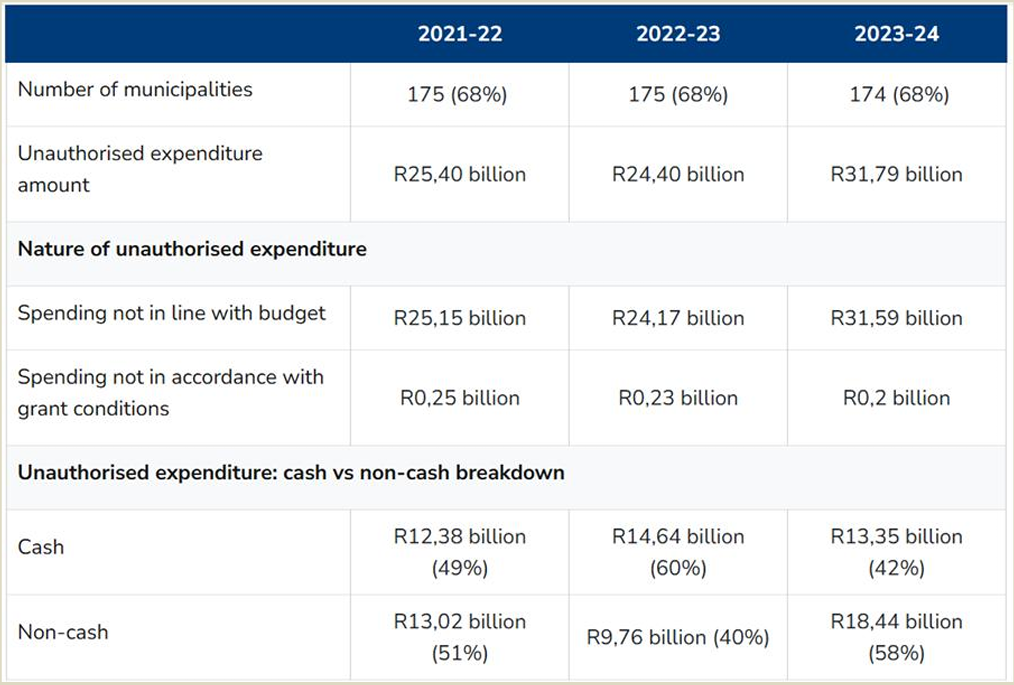
Billions are lost annually to fruitless and wasteful expenditure (R17.65 billion over three years) and unauthorised expenditure (R31.79 billion in 2023 24 alone).
SERVICE DELIVERY RISK
The AG identified deficiencies in 77% of infrastructure projects inspected, noting that poor financial management directly leads to water and electricity service failures.
LACK OF ACCOUNTABILITY
53% of municipalities failed to comply with consequence management legislation, meaning officials often face no repercussions for financial misconduct or fraud.
Clean Audit 41 (16%) Sustained by stable leadership; rare in ANC-led areas.
Unqualified with Findings 99 (39%) Not a success; indicates “pitfalls” and reliance on late corrections.
FINANCIAL MANAGEMENT
Municipal finances are in a poor state Our previous general report highlighted various weaknesses in municipal financial management, including poor financial planning, revenue deficiencies and financial losses.
We also highlighted the lack of careful spending, reduced revenue and funding, and inadequate grant management. Poor financial management means that financial health remains weak. 113 municipalities (44%) adopted unfunded budgets 68% incurred unauthorised expenditure 90 municipalities (58%) incurred deficits
Overview | 2023-24 Consolidated report on local government audit outcomes | AGSA
LOCAL GOVERNMENT AT THE COALFACE OF SERVICE DELIVERY
Local government or municipalities are usually referred to as being in the coalface of service delivery. This simply means that it is the level of government or the specific location where public services are directly provided to citizens. It describes the “front line” where policy and planning are turned into tangible actions like water, electricity, and sanitation.
In this regard it is therefore not surprising they actually occupy a very important position as they are the very first point of contact between the public and have the obligation and responsibility on whose shoulders lie the constitutional mandate to deliver basic services to the people. While it is the responsibility of the National and Provincial governments to formulate policies the execution of those policies leading to the satisfaction or dissatisfaction of the public is at local level.
Consequently the attitudes and opinions of the population towards both National and Provincial governments are a function of the performance of local government in servicing and meeting the needs of the people.
“May you live in interesting times” has long been quoted as an old Chinese curse, used ironically to imply that uninteresting times, where conflict, political turmoil and instability are absent, offer conditions far more favourable to living a longer life than do interesting times, where these elements are rife.
And although the origin of the phrase may be in question, truth be told, we do live in extremely interesting times indeed… But policy direction, legislation and political ideologies remain purely words and ideals until implemented at the coalface, and the real responsibility for turning these words into actions lies with municipalities, the public servants employed by them, and their constituents whom they serve. One of the key cornerstones of good governance in the public sector is a strong, focused – and dedicated approach to the management of risk.
Risk management has in fact been identified as a strategic imperative and no longer an option, key to the achievement of objectives and the effective utilisation of what we all know is very limited resources, in order to deliver a broad range of services.
This is no more evident than at local government level, where metropolis, districts and local municipalities are constantly focused on providing infrastructure and services in order to grow the economies, consistently delivering both essential and non-essential services, and of course maintaining the support of their constituents.
No mean feat when one considers the challenging economic and social challenges faced.
Managing Risk at the Coalface of Service Delivery | BarnOwl Software
THE IMPORTANCE OF TRUST BETWEEN THE GOVERNMENT AND THE CITIZENS
This brings us to the importance of trust between officials of government and the people.
Trust is a critical factor in relations between officials of the state and the population. Public trust is the “glue” that holds a society and its government together. It is essential for effective governance, as it ensures citizens voluntarily comply with laws, pay taxes, and support collective actions without the need for state coercion.
It is only when the government enjoys high levels of trust that it is able to execute complex long-term policies with the cooperation and support of the citizens. The people must have absolute faith in the communication by government and not think that this is a ploy to hoodwink them into voting them into power.
Once the trust is broken and the people no longer trust a word from their government- it finds expression in a variety of ways. When the trust between a government and its citizens is broken, it manifests through visible social, political, and economic symptoms. These symptoms range from passive withdrawal to active, sometimes violent, resistance.
Very often the immediate signs of broken trust is the frequency and the rise of service delivery protests. While protests are a constitutional right of citizens, but these must be conducted within the law and be peaceful. But very often we have witnessed these protests turning violent with the burning of tires and the destruction of property.
In some instances the protestors have even gone to the extent of challenging the law enforcement agencies leading into violence and the loss of life. Declining trust is closely linked to decreased voter turnout and a general lack of engagement in formal political processes. Trust is undermined when basic services—like water, electricity (e.g., load shedding), and housing—are consistently inadequate. Citizens begin to see the government as incompetent or indifferent to their daily struggles.
When citizens believe that nepotism, bribery, and state capture are the norm, they view government actions through a lens of suspicion. This perception creates a “vicious cycle” where even legitimate policies are met with skepticism. Citizens feel they no longer have a “voice” in the political system and that their participation doesn’t matter. Society becomes severely divided, with citizens more likely to identify with their specific subgroup (ethnic, regional, or political) rather than the nation as a whole.

THE CRIMINAL ELEMENT TAKES ADVANTAGE AND UNDERMINES THE AUTHORITY OF THE STATE
Under these circumstances of broken-down trust – the criminal element undermines the authority of the state by creating parallel power structures, infiltrating government institutions, and eroding the social contract between citizens and the government. These actions weaken the state’s monopoly on the legitimate use of force and its ability to provide basic services.
END
Comments
3 responses
There is a dire need to professionalize local government by employing managers with requisite skills and levels of education to manage our municipalities. All the councilors inclusive of mayors, speakers, chief whips must be part-time functionaries and thereby give the professional management to run the municipalities. That will definitely ensure less interference in the municipal administration.
Hello Sechaba
Your comment is greatly appreciated. I wish to thank you for taking time to read the posting on the website and giving us feedback. Hope to hear more from you and continued engagement.
Thank you for the article. COGTA and DOJ must consider dedicated municipal courts to deal with municipality corruption. The SIU and AFU must be permanently deployed in these troubled municipalities. The officials misconduct cannot continue to be ignored. There must be consequences.